

Hearing aids already contain microphones, wireless technology and sophisticated sound processing.
So why would someone need another device?
The answer is that different listening challenges begin in different places.
A hearing aid can process the sound that reaches the microphones at the listener’s ears. But it cannot change where a speaker is standing, move a television closer, or remove the distance between a sound source and the listener.
That is where hearing aid accessories and assistive listening devices can play a different role.
Rather than replacing the hearing aid itself, they can create another path between a specific sound source and the person listening.
Hearing aids begin with the sound that reaches the listener
Imagine two situations.
In the first, you are having a quiet conversation with someone sitting directly across from you.
In the second, the same person is speaking from the other side of a busy room.
The hearing aids may be the same in both situations, but the sound arriving at their microphones is not.
Distance, surrounding conversations, room reflections and other environmental sounds can all become part of what reaches the listener.
This is why a hearing aid user may communicate comfortably in one setting and still need additional support in another.
The accessory is not necessarily there because the hearing aid has “failed.”
It may simply address a listening situation that begins outside the hearing aid itself.
Remote microphones: bringing the microphone closer to the speaker
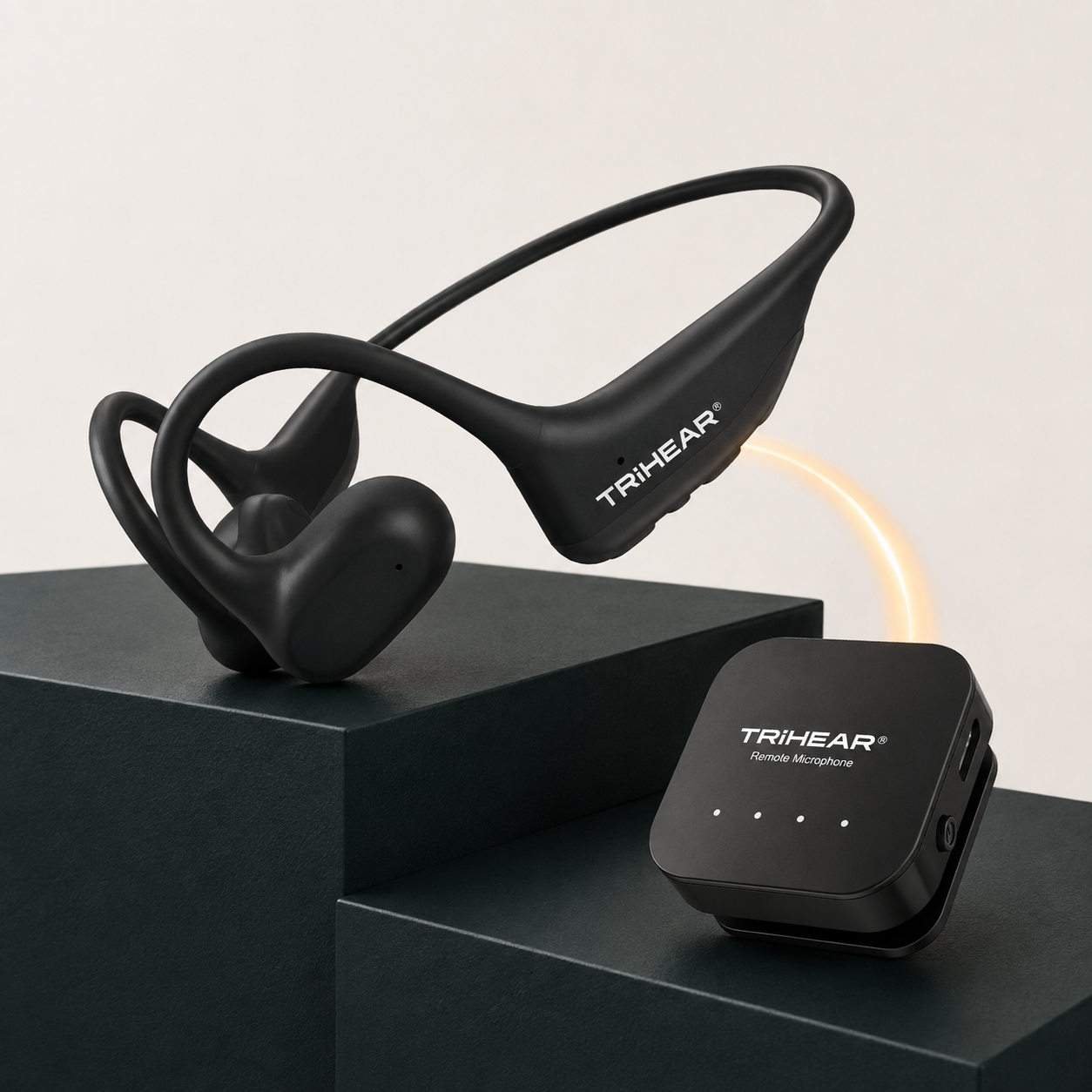
A remote microphone changes the point where the speaker’s voice is captured.
Instead of relying only on microphones located at the listener’s ears, the microphone can be placed closer to the person speaking.
The listening path becomes:
Speaker → remote microphone → compatible hearing device
This can be useful when one primary speaker matters and distance makes conversation more difficult, such as:
- across a restaurant table;
- during a meeting;
- in a classroom;
- at a lecture;
- during a conversation across a room.
The room itself does not become quieter. What changes is where the voice is picked up before it is transmitted to the listener.
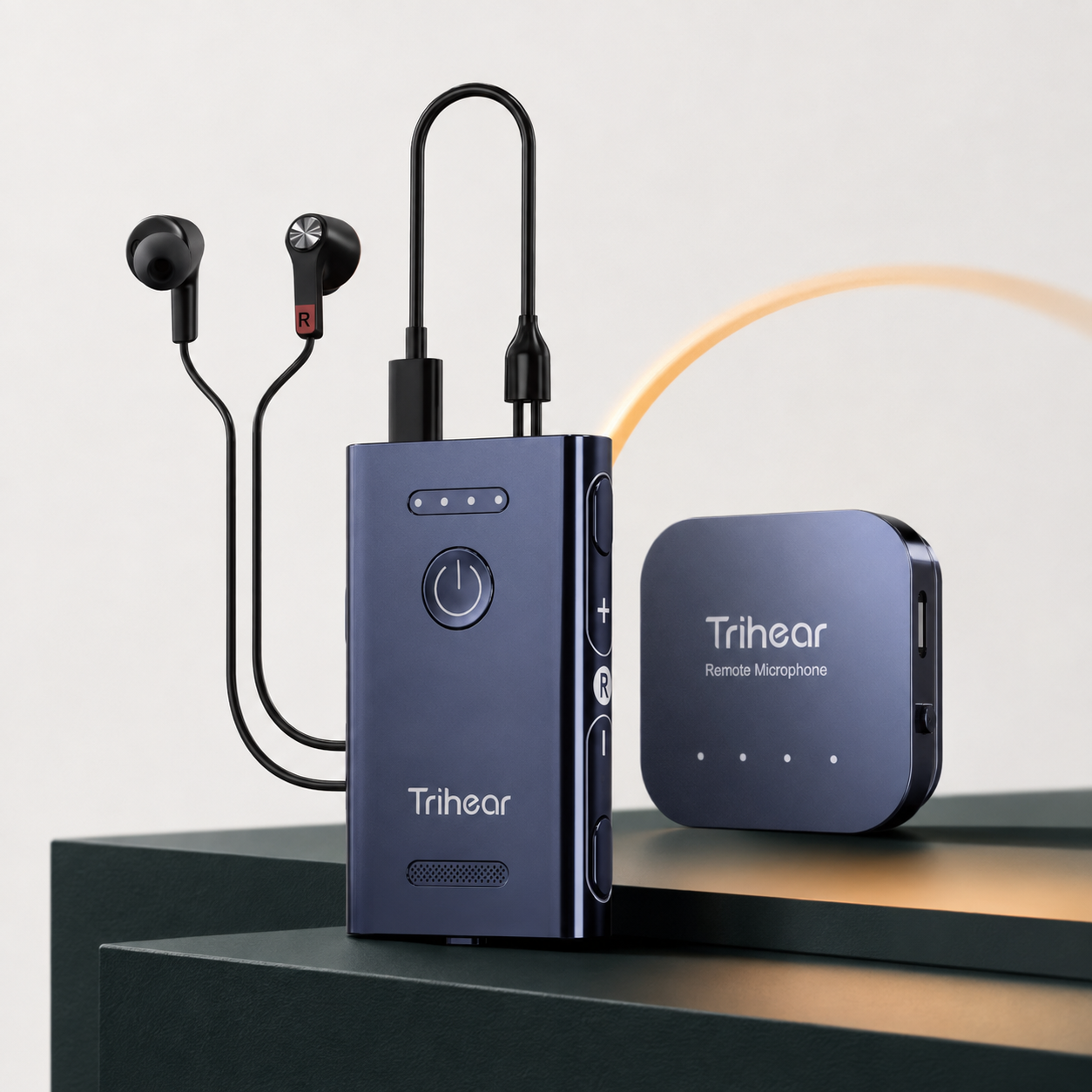
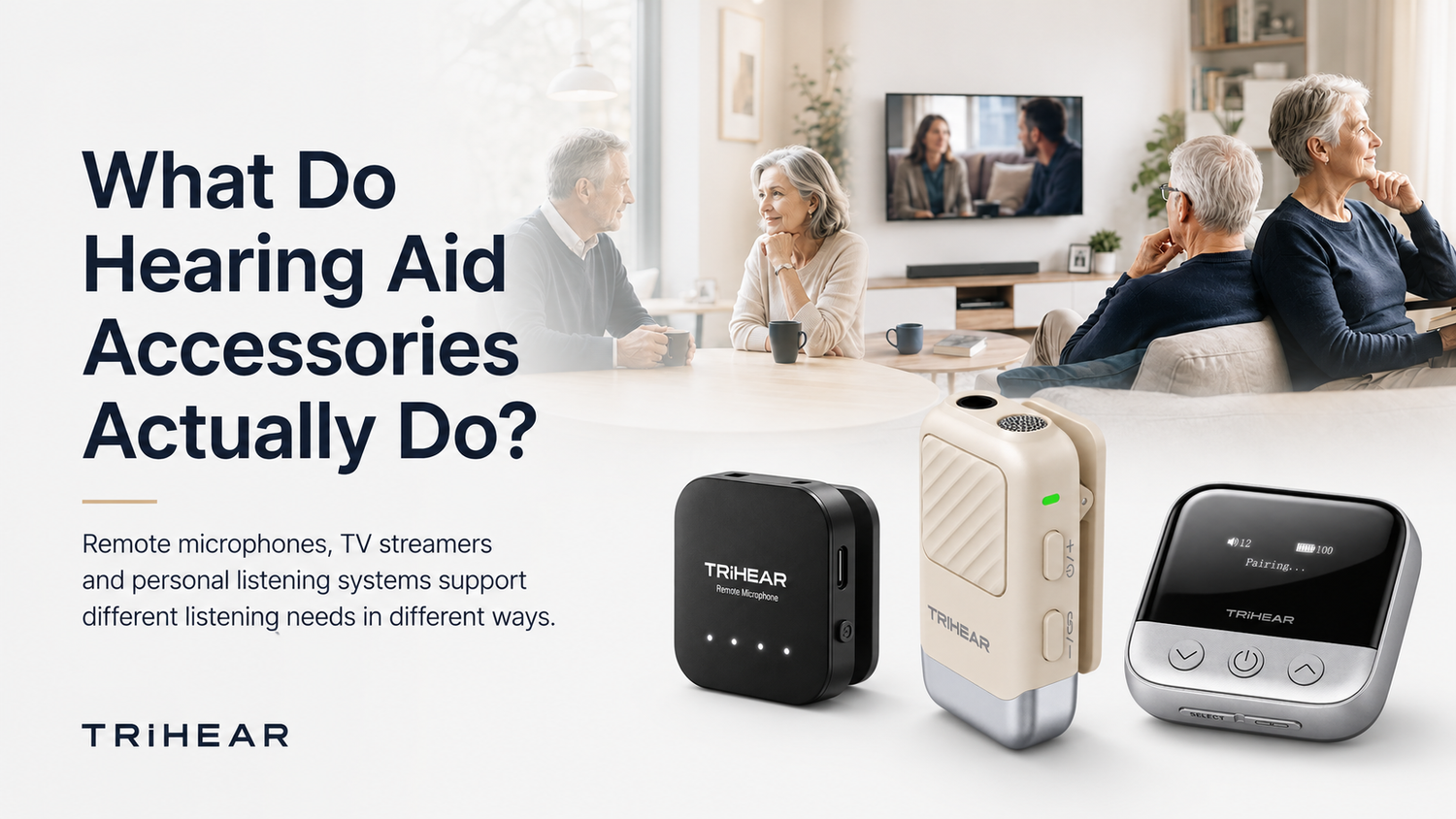
TRIHEAR SmartMic is one example of this type of accessory for selected compatible hearing aids.
The important point is not the product name, but the listening principle: capture the voice closer to its source.
TV streamers: creating a personal path from the television
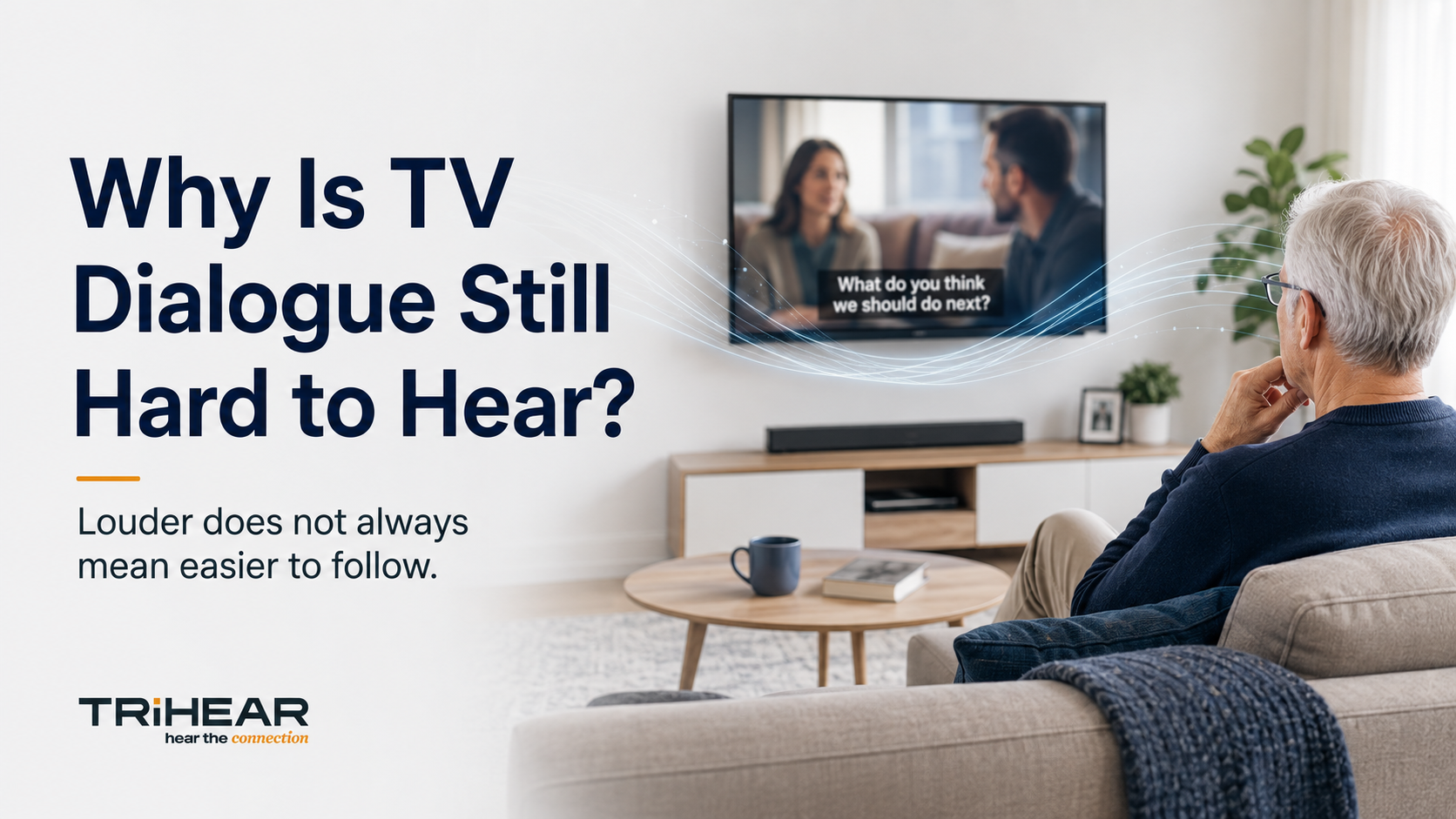
Television creates a different listening challenge.
The sound comes from a fixed source several feet or metres away, and a shared television usually has one room volume for everyone watching.
Turning the TV louder may help in some situations, but it also raises the overall room volume.
A TV streaming accessory takes a different approach.
Instead of relying only on:
TV speakers → room → listener
it can create an additional path:
TV audio → transmitter → compatible hearing device
This gives the individual listener another way to receive the television audio without depending entirely on the sound travelling through the room.
TRIHEAR ClearTV is one example of this type of TV listening accessory.
Again, the accessory is not replacing the hearing aid. It is changing the route the television audio takes to reach the listener.
Dedicated listening systems: when the receiver is part of the solution

Not every assistive listening setup depends on an existing hearing aid.
Some systems include their own receiver.
In this type of setup, the microphone or audio source and the listening receiver are designed to work together as a dedicated system.
This can make sense for users who prefer:
- physical controls;
- a separate listening device;
- a straightforward setup;
- support for a particular everyday listening situation.
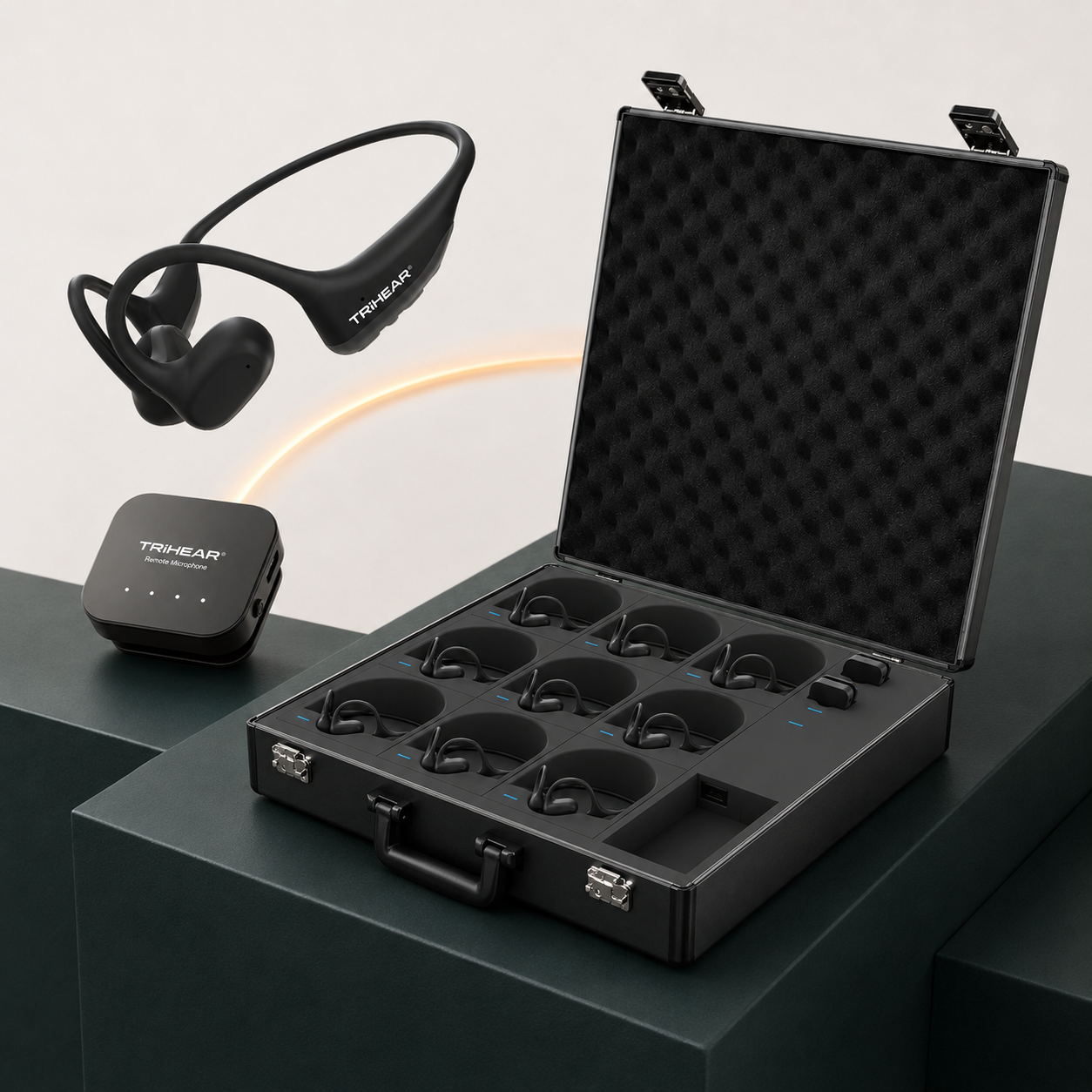
Products such as TRIHEAR Convo More and Liber represent this broader category of assistive listening systems.
They are different from hearing aid accessories that connect directly to a user’s existing hearing aids.
That distinction matters because “hearing support” is not one single product category.
Different systems can solve different parts of the listening experience.
Bluetooth does not automatically mean compatible
This is one of the most important things to understand before purchasing a hearing accessory.
Two devices may both use Bluetooth and still not be designed to communicate with each other.
Compatibility can depend on several factors, including:
- the exact hearing aid model;
- product generation;
- wireless protocol;
- firmware version;
- manufacturer accessory support.
This is why a question such as:
“Will this microphone work with my hearing aids?”
cannot always be answered simply by checking whether both devices mention Bluetooth.
For remote microphones, TV streamers and other wireless accessories, the exact receiving device matters.
Before purchasing any accessory, users should confirm compatibility with the specific hearing aid model they own.
Choose by listening situation, not by feature count

It is easy to compare accessories by the number of features they offer.
But a more useful question is:
What listening situation are you trying to solve?
If the challenge is following one person across a table, a remote microphone may be relevant.
If the main difficulty is television listening, a TV streaming solution may make more sense.
If the user prefers an independent listening setup rather than connecting to existing hearing aids, a dedicated receiver system may be worth considering.
Other questions matter too:
- What hearing devices do you already use?
- Do you prefer physical controls or app-based operation?
- Do you need support mainly at home or across several environments?
- How important are portability and ease of handling?
- Does the accessory need to work with an existing hearing aid ecosystem?
There is no single accessory that is automatically best for every user.
The right choice depends on the listening situation and the equipment already in use.
Accessories are often about extending the listening path
A hearing aid remains at the centre of hearing care for many users.
Accessories can extend how sound reaches the listener in specific situations.
A remote microphone can bring the point of speech capture closer to a speaker.
A TV streamer can create a dedicated path from the television.
A separate assistive listening system can provide its own microphone-and-receiver setup.
None of these automatically replaces the hearing aid itself.
They simply address different parts of the listening environment.
So instead of asking:
“Which accessory has the most features?”
a better starting point may be:
“What listening problem am I trying to solve?”
That question usually makes the technology much easier to understand.
Not sure which listening accessory fits your needs?
Start with the situation you want to improve—conversation over distance, TV listening, or a dedicated personal listening setup.
Explore TRIHEAR listening solutions and check compatibility before choosing the device that fits your current hearing setup.
Explore SmartMic →
Explore ClearTV →
Explore Convo More →
Explore Liber →


发表评论
此站点受 hCaptcha 保护,并且 hCaptcha 隐私政策和服务条款适用。