




A group conversation can feel very different from a one-on-one conversation.
You may hear every voice in the room.
You may even understand each person when they speak to you individually.
But when several people begin talking, changing topics, responding quickly, or speaking from different directions, following the conversation can suddenly become much harder.
This does not necessarily mean that the voices are too quiet.
Sometimes, the challenge is keeping track of who is speaking, where the voice is coming from, and what was just said.
Group conversations are widely recognized as one of the more challenging listening situations for people with hearing loss, especially when background noise is present. Unlike a two-person conversation, groups introduce less predictable speaker changes, more competition for attention, and more simultaneous conversational cues.
Hearing Everyone Is Not the Same as Following the Conversation
Imagine sitting around a dinner table with five other people.
One person begins telling a story.
Someone across the table adds a comment.
Another person laughs and responds before the first speaker has finished.
Then the topic changes.
You may technically hear all of those voices, but understanding the conversation requires more than simply detecting sound.
Your attention has to move from one speaker to another.
You need to identify where the new voice is coming from.
You need to understand enough of the current sentence to make sense of the next one.
And all of this happens in real time.
That is why someone may manage a quiet one-on-one conversation relatively well but find a family gathering, restaurant table, or meeting much more demanding.
1. The Speaker Keeps Changing
In a one-on-one conversation, the listening target is usually predictable.
You know who is speaking.
You can look toward them.
And their voice is likely coming from roughly the same direction throughout the conversation.
A group conversation is different.
The listening target may shift every few seconds.
Someone on your left begins talking.
Then someone opposite you responds.
Another person joins from farther away.
The listener has to repeatedly redirect attention toward a new voice.
Research into small-group conversations highlights this unpredictability as one of the important differences between two-person and group interactions.
2. Distance Changes From Speaker to Speaker
Not every person in a group is sitting the same distance away.
Someone beside you may be easy to hear.
Someone at the other end of the table may be much harder to follow.
The farther speech travels before reaching the listener, the more room acoustics and surrounding sound can become part of what reaches the ears.
This is one reason communication guidance for people with hearing loss often recommends reducing distance, facing the listener, and choosing quieter environments when possible.
Distance can therefore become part of the difficulty even when everyone is speaking at a normal volume.
3. Background Noise Competes With Speech
Restaurants, family gatherings, community spaces and meeting rooms rarely contain only one conversation.
There may also be:
- other people talking
- dishes and cutlery
- television or music
- air conditioning
- chairs moving
- keyboards
- room reflections
For people with hearing loss, understanding speech in background noise is a common challenge, and even relatively mild hearing difficulties can make noisy conversation more demanding.
The important point is that turning everything louder does not necessarily make one voice easier to separate from the sounds around it.
Louder may simply mean more sound.
4. People Talk Over One Another
Natural conversations are not perfectly organized.
People interrupt.
They laugh while someone else is speaking.
Two people may begin talking at the same time.
In a group, those overlaps can happen frequently.
When speech overlaps, the listener has to decide which voice to follow while other speech is competing for attention.
That can make an already fast-moving conversation even harder to track.
Missing One Sentence Can Affect What Comes Next
Missing one sentence does not always end when that sentence ends.
Suppose someone makes a comment and you miss the key word.
The next person responds with a joke.
Everyone laughs.
Then the conversation moves on.
Now you are not only trying to understand the current sentence.
You are also trying to work out what happened before it.
That creates a kind of listening catch-up.
And if it happens repeatedly, participation can become tiring.
ASHA notes that people with hearing loss may experience listening fatigue and may reduce participation in activities or social settings.
This is one reason hearing difficulty does not always look like someone saying:
“I cannot hear.”
Sometimes it may look like someone speaking less, asking fewer questions, or simply sitting quietly while the conversation continues around them.
Why Turning Up the Volume May Not Solve the Problem
When someone cannot follow a conversation, the instinctive response is often:
“Speak louder.”
Sometimes that helps.
But not always.
If the main problem is distance, overlapping speech, room acoustics, or competing voices, simply increasing volume may also increase everything else the listener is hearing.
Communication guidance generally recommends speaking clearly in a normal tone rather than shouting, reducing background noise, facing the listener, and keeping a practical conversational distance.
The goal is not always to make the room louder.
It may be to make the target voice easier to access.
Different Situations Need Different Strategies
There is no single solution for every group conversation.
The most useful strategy depends on what is making the situation difficult.
Sit Where You Can See More Speakers
Visual information can support communication.
Being able to see facial expressions, head turns and who is about to speak can make it easier to follow the flow of a conversation.
Good lighting can help for the same reason.
Reduce Unnecessary Background Noise
If possible, choose a quieter table, turn down nearby television or music, or move away from a noisy source.
The goal is to reduce competing sound rather than simply increase speech volume.
Reduce Distance When One Speaker Matters Most
Sometimes a group setting still has one primary speaker.
Examples include:
- a presentation
- a lecture
- a meeting led by one person
- a family member telling a story
- a clinician speaking during an appointment
In these situations, reducing the distance between the listener and the main speaker can make a meaningful difference.
Where a Remote Microphone Can Help
Remote microphones address distance by changing where the target voice is captured.
Instead of relying only on microphones located at the listener's ears, the remote microphone can be positioned closer to the person speaking.
The listening path becomes:
Speaker → Remote Microphone → Compatible Hearing Devices
Wireless microphone systems are commonly used when distance and background noise make communication more difficult.
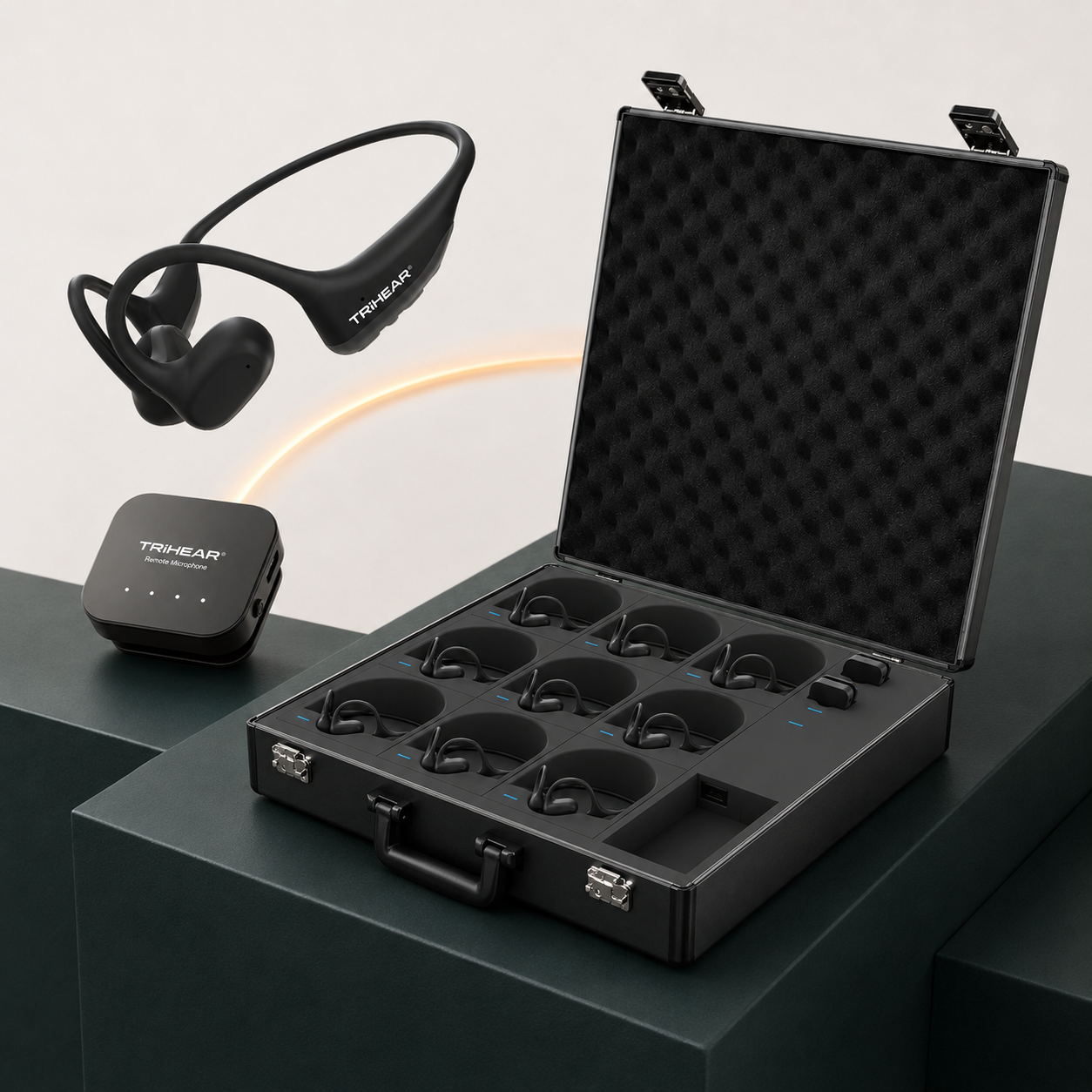
For example, Trihear SmartMic can be placed near one primary speaker and transmit that speaker's voice to selected compatible hearing aids.
That can be useful in a meeting, lecture, appointment, or across a dining table where one speaker matters most.
But there is an important limitation.
A single remote microphone is not the same as a multi-speaker microphone system.
In a fast-moving conversation where several people around a table are speaking from different directions, more complex microphone systems may be designed specifically to manage multiple speakers. Phonak, for example, offers tabletop microphone systems that can switch between or network across multiple speakers in meetings.
So the question should not simply be:
“Do I need a remote microphone?”
It should be:
“What kind of conversation am I trying to follow?”
Hearing Support Is Also About Participation
A successful conversation is not only one where words are audible.
It is one where a person can follow what is happening well enough to respond, ask questions, laugh at the right moment, and stay involved.
That is why hearing support should not be understood only as increasing sound.
Sometimes the goal is reducing distance.
Sometimes it is reducing competing noise.
Sometimes it is improving access to one important speaker.
And sometimes it is simply making the conversation easier to stay part of.
Hearing more sound is useful. Staying connected to the conversation is the bigger goal.
Explore Listening Support for Different Situations
Different listening challenges may call for different types of support.
If distance from one speaker is the main challenge, a remote microphone may be worth exploring.
If television listening is difficult, a TV streamer may provide a more direct listening path.
And if hearing difficulty affects many everyday situations, a professional hearing assessment can help clarify what kind of support may be appropriate.


Leave a comment
This site is protected by hCaptcha and the hCaptcha Privacy Policy and Terms of Service apply.